Showing posts with label Horus Heresy. Show all posts
Review: Lorgar: Bearer of the Word by Gav Thorpe
0
Long before he brought Chaos and war to the Imperium, the primarch Lorgar was raised on the world of Colchis, used as a weapon by the zealot Kor Phaeron in his bid to control the whole world. But Lorgar's destiny was far greater…

On the world of Colchis, mighty religions rule a decaying society in the name of absent gods – until the arrival of Lorgar. Primarch, prophet, leader of destiny, the Golden One is raised by Kor Phaeron, priest of the Covenant, to be his weapon in a quest for power. As religious war spreads across the planet, spearheaded by the Brotherhood of Lorgar, the primarch is plagued by visions of the future and the coming of the Emperor. To find his place in this new order, he must reach balance between the teachings of his adopted father Kor Phaeron, and the fate that he knows awaits him among the stars.
After a bit of a hiatus, I'm hopefully back in action for the foreseeable future. There are a bunch of reviews half-written on my desk, truth be told, but I figured you may be interested in the next Primarchs novel. It was recently released to the wider public who don't want to shell out a premium for limited editions, and as per usual, that means I got to read it now as well. It really is quite something!

The Story:
"Long before he brought Chaos and war to the Imperium, the primarch Lorgar was raised on the world of Colchis, used as a weapon by the zealot Kor Phaeron in his bid to control the whole world. But Lorgar's destiny was far greater…

On the world of Colchis, mighty religions rule a decaying society in the name of absent gods – until the arrival of Lorgar. Primarch, prophet, leader of destiny, the Golden One is raised by Kor Phaeron, priest of the Covenant, to be his weapon in a quest for power. As religious war spreads across the planet, spearheaded by the Brotherhood of Lorgar, the primarch is plagued by visions of the future and the coming of the Emperor. To find his place in this new order, he must reach balance between the teachings of his adopted father Kor Phaeron, and the fate that he knows awaits him among the stars."

The Review:
Lorgar: Bearer of the Word is a highly unconventional Horus Heresy/Primarchs novel. It features few boltshells fired at all and is relatively light on "present-day" Great Crusade/Horus Heresy content. Instead of showcasing the Word Bearers Legion's conquests, it showcases them only brielfy in interlude sections.
The bulk of the book? Lorgar's childhood and upbringing on Colchis. Almost the entirety of the novel is told not through the Primarch's eyes, but his "father" Kor Phaeron, probably the main architect of the entire Heresy. Besides Lorgar, the second viewpoint comes in the form of Nairo, one of Kor Phaeron's slaves at the time of Lorgar's arrival, whose views are juxtaposed against those of the ever-ambitious and corrupt archpriest of "the Powers" of Chaos.

Indeed, Lorgar: Bearer of the Word is taking the reader back to a time when the Primarchs were figures of myth and incredible awe, rather than the glorified action heroes of the later Horus Heresy series (looking at you, The Unremembered Empire...). While the big focus of the novel, as he well should be, Lorgar is kept reasonably ambiguous in certain respects, while the interpretations of his character through Kor Phaeron and Nairo tell us a lot more about themselves.

Kor Phaeron, true to form, is a bastard of the highest order. This novel does little to really humanize him. He's corrupted by the Powers-that-be from the moment we first meet him here, preaching while raising himself up above others - despite being exiled from the Holy City of Vharadesh. He is abusive, quick to anger, arrogant, an egomaniac for all his worship and sermonizing on the glories of the Pantheon. If you think you've felt disgusted by this man before, you might find that you have underestimated his spite greatly.

Growing up as the acolyte of Kor Phaeron, Lorgar actually did pretty well for himself. Despite brutal punishments even just for daring to raise questions, it seems strange that the Urizen would stay with his father-figure for so long, to the point of defending him and saving his life, obedient to a fault and despite the urgings of Nairo. The final section of the book manage to leave the reader with a new perspective on this, however - and I felt a little chilled thinking about the nature of the Aurelian's own ambition and calculations. If you've ever wondered why Lorgar may be inclined to throw his First Captain into the meat grinder of Calth and expecting him to lay down his life there, this story may give you plenty of reasons for it.

On the other hand, Nairo is a more tragic figure. Being an older slave, he is lucky to still be alive in his lord's service (or not, depending on how you look at it). He has dreams of his own, a different moral compass to all other highlighted characters and could be described as the angel in Lorgar's ear, opposed to Kor Phaeron's status as the devil. He wishes for equality and the abolishment of slavery, urges caution against his master's ambition and develops a deep friendship with the new messiah. His relationship with Lorgar highlights the best of the Primarch and gives us a look at what he might have become, had he not been stuck with the Dark Heart as his adoptive father...
The polarity between the two point of view characters does a solid job showcasing the various aspects that the young Primarch might represent for the preacher, the slave, and Colchis as a whole. Threat? Opportunity? Freedom? Conquest? Religious Truths? Maybe even a son?

Despite this being a Black Library novel, action is for the most part glossed over unless necessary to further Lorgar's (or Nairo & Kor Phaeron's) development. Late in the book, cities fall one after the other with no more than a name drop, for example, whereas the first and final compliances are showcased with a little more detail to characterize Lorgar's twin approaches: The Word, or the Mace. I applaud Gav for not making this a Primarch action flick - it is with in-depth characterizations that this Primarchs series scores, not "Bolterporn". The strongest parts of all previous books were when the Primarchs were left to talk and interact with their environments, or butt heads in the case of Russ, and the weakest when the Emperor's sons were reduced to the gods of war that they are. We've seen plenty of the latter throughout the galactic civil war already, and Primarchs should instead focus on giving the reader a greater understanding of its protagonists instead.

Lorgar: Bearer of the Word does that swimmingly. While hardly a bad word can be said about Aaron Dembski-Bowden's foundation for the Urizen via The First Heretic, Betrayer and connective tissue stories throughout, it only briefly looked at where the Aurelian came from, his very humble beginnings in the deserts of Colchis, beaten by his master and all too impressionable. Where Dembski-Bowden's Heresy work gives us a Lorgar that falls from the Emperor's Grace, and vice versa, turning from naive worship and making him a force to be reckoned with and the architect behind the Heresy itself, this prequel hands us the idealistic Lorgar, the ecclesiarch, the one to turn Colchis from the Powers to the Emperor's light, making the eventual reversal all the more tragic.

Stylistically, Gav Thorpe is also playing to his strengths. His origins in writing lore material are evident in a lot of his work, down to his narrative approach. With Lorgar being delivered in a more historically-inspired fashion and married to mythological, spiritual metaphor and accounts by what may be described as the messiah-Primarch's apostles, with a strong focus on dialogue over frantic action, the novel benefits greatly from his fairly unique style.
Thorpe even goes so far as to reinvent Colchis's whole calendar system, turning the world's days into trials in their own right, further reinforcing the hold religious tradition may have on a civilization that experiences as much as seven whole days during one full rotation of their world. While the impacts of the "Translator's Note on Time" included at the start of the novel are rarely make a massive impact on the unfolding story, they do explain much and give everything an interesting vibe. Colchisian culture is just as much a factor in Lorgar's relative childhood as his master and confidant are.

One thing that did disappoint me about the novel was the relatively abrupt end to it. Don't get me wrong, I liked the end, and it ended on an important event for Lorgar. However, I would have really liked to see a little epilogue about the Emperor and Magnus coming to meet Lorgar on Colchis, as it felt like the natural end point to Lorgar's ongoing visions about "The One". That this didn't happen confused me, as it'd have held great opportunity for Thorpe to pitch Lorgar's faith against the insidious nature of Kor Phaeron one final time and giving the reader an understanding of the Emperor's opinions on the zealotry rampant on his son's homeworld.

Another small nitpick would be that Erebus got only token mentions throughout the interlude chapters, but I guess including him in greater capacity would have diluted the exploration of Lorgar's relationship with Kor Phaeron, which I'd consider the highlight of the book.

One final note on the Dark Heart before I wrap this up, though. I saw some comments about Kor Phaeron still being depicted as a meanspirited, vile being with little redeeming qualities and that making it hard to empathize with the character. While I can see the hiccup for some people, I feel that this is exactly as it should be. Kor Phaeron was ruined by the Powers long before Lorgar appeared on Colchis. His exile made him even more bitter and wrathful, the effects of which we see here. We don't need to turn villains into victims of circumstance every time. Kor Phaeron is an utterly ambitious, zealous, calculating madman whose ambition, zealotry and madness needed a little more depth, as did his relation to Lorgar. He needed to be a fleshed-out villain, not a misunderstood tragic anti-hero. He'll never be that, and for that I am thankful. In my eyes, Lorgar: Bearer of the Word did a great job turning Kor Phaeron from an oftentimes shallow, mustache-twirling Bond-villain into a believable antagonist full of spite but also with his own insecurities and doubts, his own burdens and faults. He has become relatable, if not exactly somebody to empathize or even sympathize with.

Be that as it may, I quite enjoyed this book. I'd say it ties with Perturabo: The Hammer of Olympia for my favorite in the series so far. It lends credence to Kor Phaeron, makes subtle comments on Lorgar Aurelian, shows the immediate effects of Monarchia in its brief interludes and connects a lot of dots in a creative and engaging way. The new perspective on well-established characters has also made me enthusiastic about the Word Bearers again and I am sorely tempted to re-read The First Heretic sometime soon.
Lorgar: Bearer of the Word manages to uphold the high standard of the Primarchs series with little trouble and is essential reading for any fan of the Word Bearers or devoted acolyte of the Pantheon, if you ask me.

Lorgar: Bearer of the Word on Goodreads
read more »
Review: Restorer by Chris Wraight
0
Shiban Khan has returned to Terra. As the Warmaster draws ever closer, his body is remade and his mechanical shackles cast aside, but there are other, deeper wounds that must still be confronted before he can face battle again.
This may be a mere short story, but I figured it was worth talking about, considering how much it impressed me. The next novel review should be coming soon, once I figure out some things. In the meantime, some gushing about Chris Wraight's White Scars!

The Story:
"Shiban Khan has returned to Terra. As the Warmaster draws ever closer, his body is remade and his mechanical shackles cast aside, but there are other, deeper wounds that must still be confronted before he can face battle again."

The Review:
Restorer is a beautiful story. It perfectly highlights just what power the short story format can have, if used intelligently, as an aside to an ongoing saga. It is not a mandatory read to understand the rest of the Horus Heresy by any means, but just enough of a bonus, an epilogue chapter to a character arc from two previous novels, a novella and some shorts, that it is utterly satisfying and moving for the reader.

If you haven't read Chris Wraight's White Scars novels for the Horus Heresy, Scars and The Path of Heaven, you are doing something wrong to begin with. If you have read them, as well as the Brotherhood of the Storm novella (printed in Legacies of Betrayal), you simply owe it to yourself to read Restorer as well.

It really puts the bow on one of the most striking plotlines from Wraight's Scars stories: The friendship/rivalry between Shiban Khan and Torghun Khan. Where Brotherhood of the Storm established their divergent philosophies of war and showcased Torghun's struggles to accept his place within the Ordu of Jaghatai, and Scars delved even deeper into their origins and paths, with The Path of Heaven handing us the results of their rivalry, which presented the V Legion's own schism in microcosm, Restorer puts past errors, grievances and stubborness at rest in a very introspective way.
An important way, too, if you ask me.

Where many short stories in the Horus Heresy series turn into slices of action across the galaxy, this one brings us to the heart of Terra and gives us insights into the state of the Throneworld in the final months before the Siege. It even gives us a glimpse of the traitor forces' arrival, which may be a first. It does so in a very personal way that speaks volumes about the strength of Wraight's characterization skills. Shiban Khan, for all his faults, invites us to prepare for the impending assault of Horus Lupercal's forces - both physically and mentally.

I honestly believe that Chris got something special here. Even if this turns out to be the final piece in his White Scars saga for the Heresy, it'd be an epitaph worth remembering as one of the most poignant pieces of short fiction across the entire series. It is the final piece that I could only have hoped for after the grim events from The Path of Heaven and puts to rest one of the very few points that book disappointed me with back when I read it.

As far as the depictions of Terra itself go, I can't criticise a thing. There is a clear contrast here to Wraight's recent Inquisition novel The Carrion Throne, with both versions of Old Earth across the Millennia feeling distinct and right, giving just enough of an impression of the world to satisfy curiosity and letting imagination extrapolate the rest. The inhabitants we come across feel troubled and authentic in the situations they are presented in. This is a world just waiting on the edge of its proverbial seat, expecting the arrival of the apocalypse any day now. The dire situation was handled perfectly, in my eyes.

With all that in mind, I cannot recommend Restorer highly enough. It stands as one of the series' finest pieces of short fiction - and with as many dozens of those out there, that's got to count for something.

Restorer on Goodreads
read more »
Review: Perturabo: The Hammer of Olympia by Guy Haley
0
While crusading to build the Imperium, Perturabo, mercurial primarch of the Iron Warriors, hears ot turmoil on the world where he was raised, and abandons the crusade to return home and save his people.

Born to a life of political conflict, Perturabo was always considered a child prodigy among the people of Olympia – indeed, his philosophical and scientific works were beyond compare. But then, after his rediscovery by the Emperor and decades of thankless military campaigning on the Great Crusade, the primarch begins to resent his Legion’s place in the Imperium. When word reaches him of turmoil on his adoptive home world, he orders the Iron Warriors to abandon their campaign against the alien hrud and crush this emerging rebellion by any means necessary...
Here we go with Primarchs #4, Perturabo. It took me a week to really collect my thoughts after finishing this novel. That I'm still gushing should tell you it's good, right?

The Story:
"While crusading to build the Imperium, Perturabo, mercurial primarch of the Iron Warriors, hears ot turmoil on the world where he was raised, and abandons the crusade to return home and save his people.

Born to a life of political conflict, Perturabo was always considered a child prodigy among the people of Olympia – indeed, his philosophical and scientific works were beyond compare. But then, after his rediscovery by the Emperor and decades of thankless military campaigning on the Great Crusade, the primarch begins to resent his Legion’s place in the Imperium. When word reaches him of turmoil on his adoptive home world, he orders the Iron Warriors to abandon their campaign against the alien hrud and crush this emerging rebellion by any means necessary..."

The Review:
Perturabo: The Hammer of Olympia is the best Primarchs novel to date (or at least up to Lorgar, which recently dropped in a limited edition. I won't be reading that for a while). I feel like I'm repeating that with every book in the series, but here I can say without a doubt that Guy Haley moved me more than any of the previous authors managed to. Not just because it is a stellar, character-building novel about one of the most underappreciated Primarchs of the Heresy, but also because it struck home on a very personal level.

The novel is split into two plotlines which obviously relate to one another but still divided by almost two centuries. Both focus for the most part on Perturabo and draw different pictures of the Lord of Iron, without making the character's incarnations indistinguishable from one another.

The major plotline plays out just before the outbreak of the Horus Heresy, mere years before the disastrous betrayal at Isstvan. Perturabo and his Legion are throwing themselves into the meat grinder at the tail end of the Great Crusade, attempting to contain and exterminate a Hrud migration. I cannot remember if we ever actually saw Hrud in action in a Black Library novel - I kinda doubt it. This alien race existed for a long time, of course, and was even covered in the ancient lore tome Xenology, but the most we got was a throwaway reference here and there. The most recent examples I can think of are in fact the Horus Heresy stories featuring Barabas Dantioch, Warsmith of the Iron Warriors. Dantioch, to my delight, is a key figure in this novel, leading right up to The Iron Within by Rob Sanders from the Age of Darkness anthology.

The Hrud are a menace upon the galaxy. They don't function in the typical way beings of flesh and blood might - they distort time, travel through it and their weapons and mere presence produce warped fields that can turn humans to dust within moments, or age them for thousands of years. Fighting them proves not only a logistical nightmare, but utterly devastating in morale. This is the campaign that really broke the Iron Warriors, after decades of chafing at being handed dirty, thankless jobs.
We've heard about Perturabo's belief that the Emperor and the Imperium at large neglected him and his Legion, didn't appreciate them and used them poorly, but we never really saw why they might think that. It is one thing to be told they got bad tasks set for them, and another to truly experience how bad it could get. The Hammer of Olympia is that story that the setting, the Legion and the Primarch desperately needed. This is a vital tale to fully appreciate just what would motivate the Lord of Iron, previously shown as so enthusiastic in Graham McNeill's Magnus the Red: Master of Prospero, to break his oaths and side with Horus Lupercal. It does so marvelously.

Haley's writing of the Hrud and the way they defiend time and space reminded me of another novel of his, namely Champion of Mars; I don't want to ruin the twist of that particular scifi adventure for you (though I will say that you should go out and read it, the Kindle edition on Amazon should go for about 3 bucks only and it was very well worth more than that), but there are certain parallels to be drawn. Haley is no stranger to timey-whimey topics and I felt that the whole theme was handled very competently.

Through Dantioch, we see the meat grinder itself, the Legion's doubts and misgivings, and the price Perturabo's sons had to pay for going against their lord's own arrogance and martyr complex. I honestly love that Haley got a chance to show this fallout, after the excellent job he did with the Warsmith in Pharos. Barabas Dantioch, ever since The Iron Within, has been one of my favorite characters in the franchise. The past two years have seen him a hero with a big legacy, so it felt satisfying to follow a younger Dantioch for a change.

On the other side, we get to see Perturabo's early days. We see him arrive at his foster father's court on Olympia, grow up with, if not really under, the Tyrant of Lochos. We see him achieve great marvels and defy culture and religion. We see him reshape his adopted home world, while growing stronger in mind and body. However, we also see him shaped by the court intrigue, the paranoia of Olympia's tyrants, the assassination attempts, the heathen beliefs of priests and demagogues. We see him butt heads with his father Dammekos, bond with his sister Calliphone, and grow ever more petulant, cynical, bitter and untrusting.

Perturabo grows up feeling appreciated only for his many talents, yet not really seen for what he truly is. He feels used and abused, despite all the status and fame thrown at him. He comes to despise many aspects of his home world, subjugating it while lacking the passion to really lead it himself. He thinks others fools, and even his sister, the one person he seems to bond with, cannot be fully trusted. He keeps looking for the stars and awaits the Emperor's arrival, neglecting his subjects in turn.

Things obviously go south before long, and if you've followed the Heresy for a while, you'll probably know how things end for Olympia. I found the final chapters dealing with the Primarch's return home to be hard-hitting, uncompromising and utterly suitable to express the Legion's fall from grace while also showing them as conflicted, complex creatures with broken spirits. The Lord of Iron let his heart grow hard and weary, and it shows on his Legion and their relationship with him.

There is an exchange towards the end, between Perturabo himself and his sister, which really hit a nerve and made me reflect on the Primarch and even myself:

"Always you do things the most difficult way, and in the most painful manner. You cultivate a martyr’s complex, lurching from man to man, holding out your bleeding wrists so they might see how you hurt yourself. You brood in the shadows when all you want to do is scream, 'Look at me!' You are too arrogant to win people over through effort. You expect people to notice you there in the half-darkness, and point and shout out, 'There! There is the great Perturabo! See how he labours without complaint!'"

The entire chapter and Perturabo's conversation with Calliphone are, in my eyes, the definitive exploration of Perturabo. Everything Haley built up throughout the novel, everything we've seen in the past, is boiled down and addressed in their argument in one shape or another. I cannot possibly express just how incredibly satisfying Guy managed to sketch the Lord of Iron in that chapter alone. Even without everything else in this book, that single chapter highlights the qualities and faults of the titular character better than anything else printed about him to date. It instills an understanding of the character that goes beyond what McNeill managed in Angel Exterminatus and turns Perturabo into simultaneously one of the most tragic figures of the franchise, but also one of the most damned and twisted. Haley understood Perturabo on a fundamental level that I can only applaud.

To be frank, this is one of the few books that made me feel utterly fulfilled. It ticked all the boxes I was hoping it would. There was brutal, uncompromising action, disastrous arrogance, tragedy in motion and a sense of fully fleshed out complexity about the titular character that every single novel in this Primarchs series should be striving for. The Hammer of Olympia reaffirmed once more just how spectacular an author Guy Haley is, in my opinion. He understood the Lord of Iron and all his disparate depictions and was fully able to knit them together in a wholly compelling rendition. Perturabo: The Hammer of Olympia stands tall next to the best the Horus Heresy series has to offer.


Perturabo: The Hammer of Olympia on Goodreads
read more »
Review: Leman Russ: The Great Wolf by Chris Wraight
0
At the the height of the Great Crusade, Leman Russ and his Dark Angel brother, Lion El'Jonson, come into conflict as they pacify the world of Dulan.

Many are the sagas of Leman Russ, Lord of Winter and War, most fearsome of the Emperor’s primarch sons. At the height of the Great Crusade, his Space Wolves fight to bring the rebel world of Dulan to compliance. Enraged by the defiance of the tyrant Durath, Russ has pledged to strike him down personally – but his brother Lion El’Jonson of the Dark Angels advises more caution. With the might of two Legions arrayed against Durath, tensions nevertheless run high, and the rivalry between the Wolf and the Lion threatens to engulf them all.

This one's a few months overdue and following Magnus out of order. It took me a while to get through it, and another while to figure out my feelings on it - and how to put them best. Hopefully I managed to find a good way to do just that here.

The Story:
"At the the height of the Great Crusade, Leman Russ and his Dark Angel brother, Lion El'Jonson, come into conflict as they pacify the world of Dulan.

Many are the sagas of Leman Russ, Lord of Winter and War, most fearsome of the Emperor’s primarch sons. At the height of the Great Crusade, his Space Wolves fight to bring the rebel world of Dulan to compliance. Enraged by the defiance of the tyrant Durath, Russ has pledged to strike him down personally – but his brother Lion El’Jonson of the Dark Angels advises more caution. With the might of two Legions arrayed against Durath, tensions nevertheless run high, and the rivalry between the Wolf and the Lion threatens to engulf them all."

The Review:
Leman Russ: The Great Wolf left me conflicted. I struggled to get invested in this Primarchs novel for quite some time before I decided to just sit down and get it done. Despite having some brilliant moments that left me in awe, the almost overwhelming amount of action, especially early on, left me struggling to enjoy the book.

A big part of my problems with this one isn't just down to content, or specifically a big focus on battles. The structure of it all is what made it feel as exhausting to me as it did. Leman Russ comes along split into a mere six chapters. The first and last of these form the meta narrative, putting the rest of the book into the context of Russ telling the story of his feud with the Lion of Caliban. They are, however, not labeled as prologue and epilogue like you might expect.
The remaining four chapters in between focus on the war for Dulan, the Wolf King and the Lion's many disagreements and ends in, as lore would have it, them punching the living hell out of one another. This iconic and highly anticipated moment in 40k history was handled exceptionally well, in my opinion, whereas the early parts and what may constitute as the main plotline felt underwhelming to me.
I digress, however. While reading the book, I found many, many scene changes that could have easily warranted a chapter break. I've always been in favor of having a good amount of chapters. As long as you're not as ludicrous with it as the Star Wars: Rogue One Junior Novelization which has over 60 chapters for a mere 192 pages, I'd say a few redundant chapter breaks are preferable to having endlessly long ones. Leman Russ, to my dismay, has plenty of those.

I honestly don't know what went wrong here. A lot of times the book lent itself to thematic breaks left and right, splitting battles from more profound and introspective moments, but instead it all runs together into one mess that I found tough to keep excited over. If you're anything like me in this regard, you might struggle.

But aside from these structural issues, I found the novel too loaded with battle scenes and all they entail. The first Dulan-plotline chapter kicks off with a massive boarding action, for example. Yes, it did a good job showcasing the Wolves' way of war, their howling and single-mindedness, but it dragged on a bit too much for my liking. It isn't that Wraight didn't make an effort to make me appreciate the Jarl of the 13th Great Company. I quite liked Jorin Bloodhowl of Dekk-Tra. His role within the Legion is fairly unique, due to being one of Russ's old guard on Fenris. It is just that I never really felt much for the Dulanians. They were the stand-in antagonists. The only thing they actually had going for them for the biggest part of the novel was their advanced and odd technological level. But if that's the only thing I can associate with them for the majority of the story, then I cannot claim to find that very interesting or engaging.
It seemed like the perfect opportunity to showcase an advanced civilization that rejects the Imperium's rule, yet the only part that came close to that was the Lion's final meeting with the "Tyrant" of Dulan. That was about where I got curious about this civilization. Sadly, that's also where it became irrelevant to the rest of the book.

I guess it is to be expected somewhat to have the war on Dulan be more of a backdrop for the Wolf vs Lion story of old. We didn't really know much about the conflict before and all the interesting bits were about how Russ and Jonson started their Legion feud for good. But for that, I feel that this happened a bit too late in the book. The buildup was decent, if action-heavy, but the blows landed only in the final stages of the book. As a climax it worked wonders and made me appreciate Wraight's skill at handling Primarchs once again. But between this rivalry plotline, the Dulan war and the third plotline involving the curse of the 13th Great Company, I felt like it didn't take center stage enough.
All three plotlines needed more to them to really shine. They were serviceable, but in the end I felt that the book needed more room to properly build them up. They play into one another just well enough to not make the book feel shizophrenic, but not well enough to properly satisfy me.

Having a big timeskip after the conclusion of the big brawl, rushing through the Heresy-to-come up until the aftermath of the Imperial Palace, was awkward in my opinion as well. It is clear that Wraight wasn't going to spoil Heresy-series events, and that the book needed to work stand-alone and not hold anything mandatory for the flagship series. The encounter between the two brothers also needed to be in the book. But after being relatively slow and bogged down with battles for 80% of the book, having one of the 4 chapters available to the core-part of the novel rush through decades into the future of the HH series, felt awkward. It seems more like a pacing issue to me than anything down to Wraight's skills as an author. In fact, this chapter was one of the most engaging parts of the book for me. It just didn't fit as neatly as I've come to expect from Wraight after all I've read from him.

But this is all so very negative, isn't it? I honestly don't like being this way. My disappointment has a lot to do with the high expectations I had for this novel, based on Wraight's own work with the Space Wolves both in and out of the Horus Heresy series. And truthfully, he did a bang-up job showcasing the Great Crusade-era Legion, with quite a few bits of foreshadowing and easter eggs. The Wolves felt dangerous in many scenes, and the Lion too felt authentic to his core character archetype. He is proud, deeply arrogant, but also insanely competent. Despite all of that, Wraight made it clear that the Lord of Angels wasn't quite as cold-hearted as he often appears. It was great to see Lion El'Jonson this way. The scenes putting the lense on him were some of the best in the book.
Russ, too, did get some neat additions to his character and the fears he held for his Legion. This is a Wolf King that wants his Legion to be seen as more than simple-minded barbarians, quite in contrast to his appearance in Prospero Burns, where he seemed mostly comfortable with the idea of being underestimated by all. It is interesting to see how many aspects of Leman are the same as in chronologically later depictions, while subtle changes were made to accomodate his pre-Heresy Great Crusade incarnation.

Yes, Leman Russ: The Great Wolf is well worth reading. It may be my least-favorite Primarchs novel out of the first three and took me a good while to slog through, but it is still a competent novel that does a lot of good things for the Vlka Fenryka. I'd say the final chapters where everything comes to a head alone make this book worthwhile, despite the pacing and structural issues. It is, however, one of the books that I wish hadn't gotten the short novel treatment but instead been a full-length novel. I believe that, had that been the case, Wraight could have fully lived up to expectations and made all three plotlines compelling in their own right. Either way, it is a great read for fans of the Wolves, but also the Dark Angels and people like me who wanted to see more Great Crusade depictions of the Legions than we got so far.

Leman Russ: The Great Wolf on Goodreads
read more »
Review: Magnus the Red: Master of Prospero by Graham McNeill
0
Lord of the mystical and uncanny, Magnus the Red has long studied the ancient crafts of sorcery. A psyker without peer, save only for the Emperor himself, he commands his loyal followers of the Thousand Sons Legion in the Great Crusade, always vigilant for any lost knowledge they might recover from the remains of dead human civilisations. Now, fighting alongside his brother Perturabo of the Iron Warriors, Magnus begins to foresee an approaching nexus of fate. Will he remain true to their mutual aims, or divert his own efforts towards furthering his own mastery of the warp?
Oh joy, I didn't get much at all done in March, for various reasons. It is actually pretty demotivating to see that. So, with April on the calendar (and my moving stress dealt with!), let's get to it again.

I skipped reading the second Primarchs novel about Leman Russ so far. Well, I started to read it but felt kinda bored by the action scenes in the opening chapters. But now Magnus the Red released, and I wanted to go straight for that, especially in anticipation for The Crimson King this summer!

The Story:
"Lord of the mystical and uncanny, Magnus the Red has long studied the ancient crafts of sorcery. A psyker without peer, save only for the Emperor himself, he commands his loyal followers of the Thousand Sons Legion in the Great Crusade, always vigilant for any lost knowledge they might recover from the remains of dead human civilisations. Now, fighting alongside his brother Perturabo of the Iron Warriors, Magnus begins to foresee an approaching nexus of fate. Will he remain true to their mutual aims, or divert his own efforts towards furthering his own mastery of the warp?"


The Review:
Magnus the Red: Master of Prospero is, overall, a damn good novel for all manner of reasons. I have some gripes which relate to the usual issues with Graham McNeill's works, but at the end of the day, it worked. It felt like a fresh story, with early Great Crusade Legions still growing into what they'd become by the Heresy. Out of the three Primarchs novels out so far, I might like this best (though admittedly I stopped reading Leman Russ for the time being; the action-heavy start just didn't get me fully invested).

To get my big bugbear out of the way first, though: Yes, McNeill once again "recycles" his characters from previous books. Not only do we see Ahzek Ahriman, Hathor Maat, Phosis T'Kar and Atharva, who at least make sense being here in a Thousand Sons novel, but Graham also included his old Storm of Iron/Angel Exterminatus cast; Forrix, Obax Zakayo and Barban Falk accompany Perturabo, and while Forrix at least made sense considering his rank, I found the inclusion of Zakayo and Falk to be... redundant.
I didn't feel it added to the plot, and their roles could have easily filled by other, non-established Iron Warriors. In fact, I cannot recall a single, lasting Legion character of either TS or IW that we did not see before in another McNeill novel. Where both David Annandale and Chris Wraight have made efforts to play with a new roster of fresh characters, Graham is, once again, resting on his old creations. It strikes me as lazy, even if I can see why he would do it. Adding to that somewhat on-the-nose foreshadowing for Forrix and co, regarding Storm of Iron, didn't help me feel good about it.

Be that as it may, though, the rest of the book was pretty unconventional. Rather than big warfare, we get a logistics problem here. What fighting there is tends to be limited to short scenes, not drawn-out engagements, and McNeill implies more of the overall conflict than he clearly spells out. I bloody loved that!
I've talked about "battle fatigue" a few times before, and after seeing both previous Primarchs novels being heavy on action, this came as a pleasant surprise and relief. I didn't have to trudge through chapters full of bolter shells and psychic fizzing, but got to see a desperate evacuation of a doomed world that allowed for plenty of character development for Magnus, his sons and even Perturabo.

That isn't to say that the action was unsatisfying, not at all. It was on point and had a purpose beyond ticking checkboxes for the editors. There are spectacular scenes here, showcasing the psychic might of the Thousand Sons and their Primarch, and Forrix kicks ass. But everything serves the plot and the greater moral dilemma. McNeill made the correct choice going this route, in my eyes. It is too easy to fall into the trap of writing superhero-Primarchs doing everything by themselves. True enough, Magnus goes far and beyond what you might expect here, but it is all well-grounded and comes at a price. What he does here shapes his character in a way I didn't expect, and Perturabo too has some great scenes, including lines of dialogue that I'd quote here if they didn't involve spoiling some very well-handled scenes.

Where the book really shines in my eyes however is in depicting the youthful naiveté of the two Legions. They are still highly idealistic and think they can do no wrong. Many lines have not yet been crossed, and Perturabo and his Legion aren't worn down yet by disregard and being used as blunt tools of siege warfare. The sons of Magnus are still a little reluctant to show the full extent of their powers to the other Legions. It was refreshing, really, to see some characters like Ahriman still a little uncertain of their true potential, though I am a little disappointed in how his role grew exponentially throughout the book, taking the spotlight from Atharva. I'll really have to re-read A Thousand Sons soon as well, I think, even if just to see if Hathor Maat was as much of an annoyance there too...

The scale of the story, the early look at the Legions, the well-paced action and awesome twists that link back to the Sons' search for lost knowledge all made this book a truly enjoyable experience for me. I can overlook my nitpicks about recycled characters and heavy-handed foreshadowing if the overall framework and many of the close-ups of the story are as satisfying as with this novel. The book stands on its own pretty damn well, while offering readers of A Thousand Sons and Angel Exterminatus some really neat looks behind the curtain. If you've ever been interested in reading more about the Sons and their early days, this is about as good as it gets.


Magnus the Red: Master of Prospero on Goodreads
read more »
Review: Exocytosis by James Swallow
0
Having long been hounded across the galaxy by the Dark Angels, First Captain Typhon of the Death Guard has limped his fleet to sanctuary in Segmentum Obscurus - as a guest of the separatist Luther of Caliban, no less. On the world of Zaramund, long a symbol of brotherhood amongst the Legions, Typhon begins to suspect that a new form of corruption has followed him out of the wider war. Will he embrace it, or escape into the darkness once more?

It's another step towards what we all know is coming for the Death Guard and Captain Typhon. Is it time that he embraced his destiny as a pawn of the Plague Lord?
Another long-delayed review. Life gets in the way more often than you'd like, doesn't it? Either way, this was coming one day or another. It is another advent story, of course.

The Story:
"Having long been hounded across the galaxy by the Dark Angels, First Captain Typhon of the Death Guard has limped his fleet to sanctuary in Segmentum Obscurus - as a guest of the separatist Luther of Caliban, no less. On the world of Zaramund, long a symbol of brotherhood amongst the Legions, Typhon begins to suspect that a new form of corruption has followed him out of the wider war. Will he embrace it, or escape into the darkness once more?

It's another step towards what we all know is coming for the Death Guard and Captain Typhon. Is it time that he embraced his destiny as a pawn of the Plague Lord?"

The Review:
Exocytosis is yet another neat, character-focused Horus Heresy short story. It is a sequel to Gav Thorpe's Angels of Caliban, continuing on from the novel's epilogue. If you haven't read it prior to this story, I'd recommend that you do. Not only was it pretty good, but the Caliban plotlines and foreshadowing lead right into the situation we've got here.

Calas Typhon, First Captain of the Death Guard, has come to Zaramund, and found Luther of the Dark Angels waiting for him. Typhon and crew have been hounded by loyalist Dark Angels for years now, so tensions with Luther are a given. Only a modicum of courtesy is extended towards the Grand Master, yet materiel and refugee are accepted nonetheless. But the Death Guard, and Typhon in particular, are keeping many secrets here, almost mirroring the Dark Angels themselves. And then Typhon gets confronted with a grim truth that sets him truly on course to become Typhus, the Herald of Nurgle we all know from the 41st Millennium.

To be frank, I was a bit worried about Swallow taking back the Death Guard after all these years. He set a certain tone for the Legion in Flight of the Eisenstein - but that was almost 10 years ago! Since then, he had very little to do with the Death Guard at large, despite his long-running Garro sub-series. In the meantime, many other authors have tackled Mortarion and the Death Guard, from Graham McNeill over Gav Thorpe to Chris Wraight, and I don't think it controversial to say that out of all of the depictions, I am particularly keen on Wraight's. Indeed, this story, along with Wraight's The Path of Heaven, will undoubtedly lead right into the upcoming fall of the Death Guard novel. Needless to say, I was hoping Chris would score the book, but after reading Exocytosis, I am more torn on the matter.

That is to say, I enjoyed this short story a good deal. Typhon takes the center of the stage, though I would have liked to see a little more of Luther, Zahariel and co. The few nuggets of info we get there are worthwhile in my opinion, and show the tensions within the Dark Angels pretty well. But it really is about Typhon, his eventual fate and the beginning of the true turn of the Death Guard from traitors to swollen, pustulent abominations in the service of the god of pestilence.
Swallow offers a few callbacks to ideas he put onto the table back in Eisenstein, which I appreciate greatly, and Typhon feels a bit more nuanced than I thought him in Thorpe's The Lion. The semi-religious themes tackled here also were a nice touch, though I was shaking my head over the one and only Dark Angel who could've had a chance of changing the inevitable.

Overall this isn't great on action or big Legion progression. A lot of it is setup for what is to come, to bring Typhon, an oft-neglected character, back into the spotlight. However, it is good setup with a good character focus that was sorely needed. It is competently written and fits neatly into the current state of the Heresy. If it heralds a return to the Death Guard for Swallow, he is welcome to go ahead with it.

Exocytosis on Goodreads
read more »
Review: Cybernetica by Rob Sanders
0
The Red Planet has fallen. The Dark Mechanicum must be stopped to ensure Terra's safety. An agent is despatched with a single goal: exterminate all life on Mars.

Soon after word reached Terra of Horus's nascent rebellion, Mars fell. Rogue elements within the Mechanicum priesthood, stirred by the Warmaster's promises of independence and prosperity, turned against the Imperium and forced the primarch Rogal Dorn to order an impenetrable blockade of the Red Planet. Now it has become clear that the corruption has spread too deep, and that more drastic measures must be taken if the Forge World Principal is to be reclaimed. Calling upon the expertise of those who witnessed the so-called 'Death of Innocence' firsthand, Lord Dorn and Malcador the Sigillite consider their final solution - the complete extermination of all life on Mars.
This is a review that I found surprisingly easy to write, so I figured I'd use it to get back into action here. Still sick, I'm afraid, but I'm getting back into the groove day by day. I wish this book had turned out better, however.

The Story:
"The Red Planet has fallen. The Dark Mechanicum must be stopped to ensure Terra's safety. An agent is despatched with a single goal: exterminate all life on Mars.

Soon after word reached Terra of Horus's nascent rebellion, Mars fell. Rogue elements within the Mechanicum priesthood, stirred by the Warmaster's promises of independence and prosperity, turned against the Imperium and forced the primarch Rogal Dorn to order an impenetrable blockade of the Red Planet. Now it has become clear that the corruption has spread too deep, and that more drastic measures must be taken if the Forge World Principal is to be reclaimed. Calling upon the expertise of those who witnessed the so-called 'Death of Innocence' firsthand, Lord Dorn and Malcador the Sigillite consider their final solution - the complete extermination of all life on Mars."

Disclaimer
I have read & reviewed this novella while being sick. It is at least possible that my view on the book is harsher as a result of outside factors.

The Review:
Cybernetica is one of the few Horus Heresy books that I felt were more of a chore to read than a pleasant experience. I did not enjoy it. I had to re-read sections over and over because they just wouldn't sink in, or I'd go back to re-read parts out of a feeling I missed something vital, especially after seeing praise for said sections online. But in the end I still feel unimpressed and dissatisfied with the story and its characters, and the big amount of action sequences.

I've mentioned the "battle-fatigue" problem somewhere before, though I can't remember which review it was. The term strikes me as important with Cybernetica too. It is full of action setpieces, some even pretty good, but the sheer volume of them compared to character development, interaction between cast members, and actual ongoings outside of he-strikes-I-strike moments is so mind-numbing to me, that I feel turned off from reading altogether if I can't get through the rest sooner rather than later. I build up an apathy towards the book and while that can get reverted if the book improves, Cybernetica never did. It left me cold.

My biggest complaint about the book is that it had so much promise to be something cool, exciting and with plenty of depth, yet chose not to be such. It had ample opportunity to be more than the sum of its parts, yet discarded these opportunities early on. When looking at the book, I can see many ways it could have gone differently in more fulfilling directions, yet reality is different.

Even looking at the cover art I see a massive missed opportunity. The diverse-Legion-Techmarines-doing-shit-on-Mars angle that the book outwardly promises with its Raven Guard, Ultramarine, Salamander and co lineup is compressed to barely two chapters. By the end of chapter two, the Raven Guard protagonist is on his own. The rest are goners, and never even got out of their tower or the hangar that is the stage for the first big (present-day) action setpiece. Yes, there's more action in flashbacks right off the start too. Either way, the idea of a dirty dozen infiltration mission on the Red Planet is discarded barely a quarter through the book, and that is where my enjoyment increasingly evaporated.

I liked the initial banter between the Techmarine initiates. They were representatives of their individual Chapters, with their own quirks and specialties. They argued, they assessed the situation, they decided to get out. They died. The book died with them. Instead of taking this entire angle of Legiones Astartes loyal to the Emperor over their Legions or the Omnissiah due to spending 30 years in training, which could have offered plenty of conflict between the group, have discussion of loyalties and their beliefs in how to purge Mars, Sanders scrapped it so quickly, it boggles my mind.

The Carrion, the Raven Guard protagonist, survives and reaches Terra. His struggles to get off Mars are handled off-page, between chapters. So is his recruitment to the Knights Errant. So is his own emotional development. It felt like there was too much slipping through the cracks at this point already that I found myself disconnected from the protagonist by chapter three of seven, the last of which he is not even in.

It didn't help that the only other character with a speaking role on his mission back on Mars ended up being a madman-heretek with what seemed like 5 lines throughout the rest of the story, one of which was "Tick, tock, tick, tock". Don't get me wrong, I liked Octal Bool's appearance in early flashbacks from his trial, and the idea behind him. But he was severely underused and his madness didn't allow for organic back and forth between him and the Carrion. His role made the Knight Errant feel even more isolated among his combat servitors and robot cohort.

I'm a reader who appreciates characters and their actions probably beyond everything else. Give me dialogue over swordblows any day. In that regard, Cybernetica is an utter failure. The showcasing of lumbering, emotionless machines doing their masters' bidding just doesn't appeal to me. It robbed the book of the type of content I enjoy most. But even then there would have been ways around it! The Tabula Myriad, the abominable AI construct that Octal Bool makes such a fuss over, could have offered a lot of conflict here. Instead, it cannot talk, and its influence is barely felt until the very end. It thinks and directs the other constructs but that's about it for the most part. It has enough impact on action scenes but barely any on the reader or the protagonists up until the climax. I almost forgot it was even there at times.

This is where I have to ask myself how this even happened. You got an actual artificial intelligence that came to the conclusion all the meat-things need to be purged because of their weakness and predicted, at least in part, a schism between humanity's factions. It even made plans and arrangements to achieve said purge and can influence machines around it. This is a setup brimming with potential for excitement and conflict and moral deliberations. It seems like a rich opportunity for any storyteller. And yet it takes a passive role, being a tool to achieve the mission instead of feeling like an integral part to it. Even the mad heretek worshipping it is sidelined for yet another fight against the Mechanicum's constructs.

The fights were technically good, and could have served a good dramatic purpose, but instead their volume throughout felt overbearing. With the book's original publishing timeframe, I have to wonder if it suffered from the infamous time in Black Library's life where Games Workshop proper exerted too much influence over the publishing arm. 2015 saw the peak of marketing brochure-like releases, with short stories presenting the release of the week in a super positive light and what not. I got a similar feeling here. Kastelan, Castellax, Vorax etc, the book highlights a lot of 2015's releases very prominently, to the point of annoyance. It would not surprise me in the least if this was a corporate mandate in line with other policy changes back then, rather than Rob's own vision that had been in the creative stages for a long time before, as evidenced by the name of the book being declared years earlier at events.
Either way, the product that ended up on the market read too much like an action piece than a moe introspective, exploratory epic of the Horus Heresy variety. That's what happens when you spew lightning at opponents or use magnet fists and put an Astartes into a giant Imperial Knight-sized mecha-body.

Despite all the missed opportunities, this is also the longest Horus Heresy novella so far, I believe. It is noticeably longer than Aurelian, the Corax novellas or other. Referring to the audiobook runtimes given by Black Library (since they don't give actual page numbers for their releases anymore), it compares closest to Rob Sanders' own The Honoured short novel for Betrayal at Calth, and is barely 10 minutes shorter than Sanders' Shadow of Ullanor for The Beast Arises. Yet it achieves so little that I thought was actually of consequence or gave a different perspective on the war with Mars, it has been one of the few books I end up thinking wasted my time.

The prose is, as often with Sanders, a bit heavy for my taste. Some people will love it, others will find it needlessly complex in places. He conjures up thick imagery, but it also requires you to glue yourself to the page to not miss a beat. I admit that this was difficult for me this time, due to being sick and my head buzzing with scrap code as it is. Maybe my lack of enjoyment is at least in part down to that.

I can definitely say that one stylistic trait of Sanders is not to my taste at all, though: He barely ever gives you breathing room within any given chapter of his books. Where in most books you'll come across scene breaks, blank lines that invite a short break, or allow you to close the book at and get off your train, Sanders writes non-stop. You either finish a chapter or re-read sections just to get back to where you left off. This is the primary factor that has so far discouraged me from reading his Atlas Infernal, even though it has been sitting on my shelf since it released. If I have to get through about 40 pages without breaks just to get out of the prologue, my enthusiasm dwindles. Cybernetica is similar to that, and as a result felt exhausting to read.

Cybernetica lost me. Between the lack of more esoteric discussion, the battles that overstayed their welcome, the weird, out-of-character-despite-dark-code boss waiting at the end, the lack of poignant dialogue, the mission objective we all know from the start will not be achieved no matter what, and the disconnect from the characters, all presented in a relentless avalanche, this has to be one of my least favorite books in the entire Horus Heresy series. It didn't stimulate, it exhausted me.

Cybernetica on Goodreads
read more »
Review: The Painted Count by Guy Haley
0
Following the disastrous invasion of Sotha and the dimming of the Pharos' light, Gendor Skraivok languishes on board the VIII Legion flagship Nightfall. Distrusted by his allies and despised by his rivals, he nonetheless means to claw back leadership of the Night Lords from the pretender Captain Shang, by fair means or foul. And, rather than a portent of doom, the daemonic blade that seems to have chosen him as its bearer may be the answer…
Here's yet another Horus Heresy short story from the Black Library Advent Calendar. Getting there!

The Story:
"Following the disastrous invasion of Sotha and the dimming of the Pharos' light, Gendor Skraivok languishes on board the VIII Legion flagship Nightfall. Distrusted by his allies and despised by his rivals, he nonetheless means to claw back leadership of the Night Lords from the pretender Captain Shang, by fair means or foul. And, rather than a portent of doom, the daemonic blade that seems to have chosen him as its bearer may be the answer…"

The Review:
The Painted Count follows on shortly after the events of Pharos. The novel is mandatory reading before you go into this short story, otherwise you'd be missing out. The short story has many call-backs to the novel and even a slice of Vulkan Lives, which surprised me.

In general, this is a more direct character piece on Skraivok and his standing within the Night Lords Legion. Where Pharos left us with questions as to his fate, and that of the Nightfall, The Painted Count aims to give answers. Skraivok is forced to embrace uncomfortable truths and comes to heads with Konrad Curze's equerry Shang, who first appeared way back when in The Dark King. The two represent the different spectrums of the Legion; one clinging to Curze and wanting vengeance, the other looking forward and trying to make their own way. Of course, the inherent selfishness of the Legion gets in the way of a fair vote on the new leadership, so things take some turns left and right.

The story as a whole serves as a stepping stone between Pharos and the assault on the Sol System. The Night Lords are being maneuvered into place, and we get a good close-up of Skraivok and his own philosophy. I can't say I disliked the Painted Count by any means - Haley's writing puts him as insane in his sanity. My one disappointment with the story was that it didn't explore Captain Shang well enough for my liking. This was Skraivok's show, of course, but a bit more dialogue from Shang, or maybe a scene from his point of view, could have benefitted the story and made it into a great one for me.

As it stands, The Painted Count was an exciting and satisfying read, establishing Gendor Skraivok as a name to watch out for in future installments of the series. It is a worthy part in the overarching Night Lords storyline of the Horus Heresy, and Haley's portrayal of the Legion is, in my eyes, absolutely fitting.

The Painted Count on Goodreads
read more »
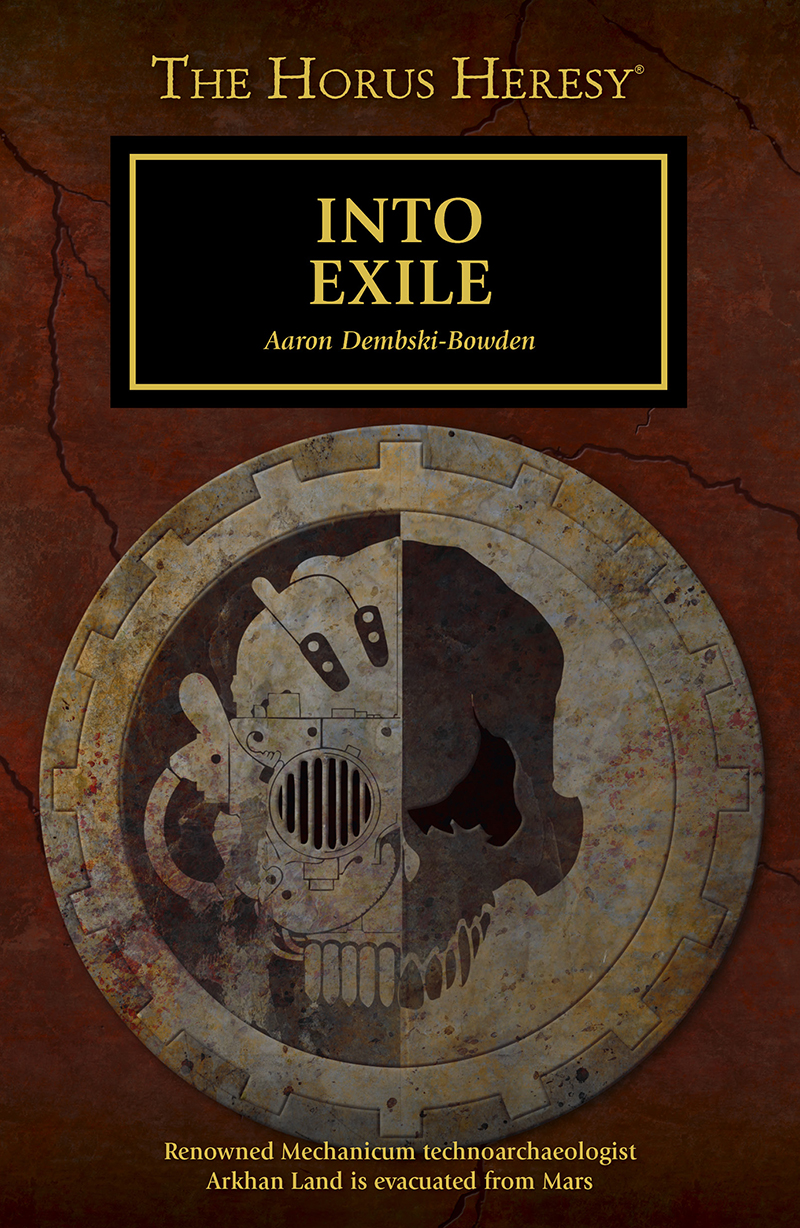
Review: Into Exile by Aaron Dembski-Bowden
0
When the traitorous allies of Horus and Kelbor-Hal seized Mars, they sent elite hunters to apprehend key targets and ensure that any loyal resistance would fail. One such target was the legendary technoarchaeologist Arkhan Land, the discoverer of many lost treasures and curiosities from mankind's Golden Age - and the Imperial Fists cannot allow such a valuable mind to fall into the hands of the enemy. Does Land have good reason to fear his apparent saviours?
Another Horus Heresy story from the Black Library Advent Calendar. This one's a prequel to The Master of Mankind and features Arkhan Land, who was one of my favorite characters from the numbered novel.

The Story:
" When the traitorous allies of Horus and Kelbor-Hal seized Mars, they sent elite hunters to apprehend key targets and ensure that any loyal resistance would fail. One such target was the legendary technoarchaeologist Arkhan Land, the discoverer of many lost treasures and curiosities from mankind's Golden Age - and the Imperial Fists cannot allow such a valuable mind to fall into the hands of the enemy. Does Land have good reason to fear his apparent saviours?"

The Review:
Into Exile is a story told in reverse, featuring Arkhan Land's escape from sacred Mars. Hunted by a Mechanicum construct and protected by a single Imperial Fists legionary, Arkhan has to swallow his pride and get to safety. This is also set during the initial evacuation from Mars, which we've seen tackled by Mechanicum in the single-digit novels of the series.

Sadly, it didn't work for me. The concept seems novel at first, intriguing, but I didn't feel like it added much, if anything, to start with the conclusion and work back towards the beginning.
There were no unexpected twists that might have turned the plot on its head in ways that complimented the unique style, and knowing exactly how a character would meet his end made the whole evacuation chase here feel rather dull. Knowing that the hero escapes (which was obvious from him being a part of The Master of Mankind) and the protector sacrifices himself in the very first scene, made the tension evaporate for me.

I liked the character of Arkhan once again, but Nicanor felt flat to me. Stoic, stubborn and dutiful, but that's an Imperial Fist in a nutshell anyway. The plot itself is simple and filling a gap that I don't think really needed plugging. I'm glad to see AD-B experimenting with the short story format once again, which I loved in previous advent calendar series, but I'm not sure the subject matter lent itself to the test.

Into Exile on Goodreads
read more »
Review: The Grey Raven by Gav Thorpe
0
Balsar Kurthuri of the Raven Guard has always followed his primarch's orders. When the Edict of Nikaea forbade psykers within the Legions, he returned to the line squads without a second thought. When the Warmaster's treachery became known, he gave freely of his powers. Now, as the war appears to be entering its final, grim stages, at Lord Corax's command he must return to Terra to face judgement for the apparent crime of unswerving loyalty…
Skipping ahead in Black Library's Advent Calendar series, day 7 has a sequel to Corax for us. It wraps up one of the storylines left dangling by Weregeld and gives a little status update on the state of the Sol system.

The Story:
" Balsar Kurthuri of the Raven Guard has always followed his primarch's orders. When the Edict of Nikaea forbade psykers within the Legions, he returned to the line squads without a second thought. When the Warmaster's treachery became known, he gave freely of his powers. Now, as the war appears to be entering its final, grim stages, at Lord Corax's command he must return to Terra to face judgement for the apparent crime of unswerving loyalty…"

The Review:
Arriving at Terra alongside Captain Noriz and his Imperial Fists, and Arcatus Vindix Centurio of the Custodian Guard, ex-Librarian Balsar Kurthuri is confronted with a big problem: The Custodes turn on him and attempt to take him out. With emergency protocols in place, there is nothing left for Kurthuri other than to attempt escape, eluding his pursuers while restraining himself. He gave an oath to ban himself from using his psychic powers again, which proves tricky.

I quite liked the story. It is an action-heavy chase, and while as a reader of the series the results and twists were utterly obvious (which they should be after the many Malcador-related stories we've had by now), which isn't helped by the title either, I enjoyed the ride. Points can be made for potential losses not being worth risking, but the way it was executed worked for me. The stress of the situation bubbled to the surface neatly and there was some much appreciated time with Noriz, who I liked quite a bit in Deliverance Lost and Corax.

The story also hammered home the gulf between Astartes and Custodes, with Arcatus being a badass. Sure, we just got that with The Master of Mankind anyway, but here the Custodes are on the attack, not the back foot. There was also some neat little bonding between the lone Raven Guard and Noriz and co, due to their years together under Corax.

The big negative for me here was that it was damn predictable. The moment Arcatus turned on Balsar, I knew where it was headed. I knew where Balsar Kurthuri would end up, and what the intentions were. There were still some surprises, of course, but if you've read The Silent War, book 37 in the series, you might consider the short story as transparent as me.

The Grey Raven on Goodreads
read more »
Review: Perpetual by Dan Abnett
0
Escaping from ruined Calth, Oll Persson and his band of refugees are trapped on a dark, forgotten world. But the enemy draws near, and immortality may not be enough to survive...

Oll Persson stands apart from the rest of mankind. He is one of the old ones, one of the undying. One of the Perpetuals. Now, fleeing from the ruins of Calth with his band of fellow refugees, the vagaries of the warp have brought him through the backways of time and space to a city that rests on the edge of oblivion... and no further. The path has ended abruptly, and Oll's enemies are finally closing in. Will his immortality be enough to save him this time?
It is that time of the year again. Black Library has launched its Advent Calendar 2016, and I'll be picking and this year I'll be choosing notable entries from the list to review quickly. That means I'll probably skip over all the Age of Sigmar stuff by default, truth be told.
Day One had a Horus Heresy audio drama in store for us, and by Dan Abnett no less! Notable enough, I'd wager, so let's have a look.

The Story:
"Escaping from ruined Calth, Oll Persson and his band of refugees are trapped on a dark, forgotten world. But the enemy draws near, and immortality may not be enough to survive...
Oll Persson stands apart from the rest of mankind. He is one of the old ones, one of the undying. One of the Perpetuals. Now, fleeing from the ruins of Calth with his band of fellow refugees, the vagaries of the warp have brought him through the backways of time and space to a city that rests on the edge of oblivion... and no further. The path has ended abruptly, and Oll's enemies are finally closing in. Will his immortality be enough to save him this time?"

The Review:
I enjoyed Perpetual, especially for the actors' performances, but in the end it is a mere stepping stone for the Ollanius the Pious plotline.

It doesn't really feel significant on its own, and is more of an extension to the end of Know No Fear and Mark of Calth's Unmarked. There is some decent deception going on, and it is an appreciated status update on Oll and co, and gives some neat little nuggets of lore on the millennia leading up to the Great Crusade and Heresy era, but a lot of it felt a bit rehashed. The audio drama has to reiterate information on Oll's nature, his views on the Emperor, his habits and what not, which seems necessary seeing how long ago Unmarked was published, let alone Know No Fear, but takes up valuable time in the audio format, which I'd rather seen used to progress the plot more dynamically.

That being said, I enjoyed the actors, and felt they added a lot of character to the group of survivors. Penelope Rawlins did a neat job as Katt, and her role in what's to come is probably the most exciting part to me. Hearing John Grammaticus in a drama for the first time also felt neat, and if that's how he talks, I can dig that.

In the end though I am left wondering if this wasn't written years ago as a short story, like most of Abnett's more recent works for Black Library, and simply adapted for the BL's Advent 2016 in audio, now that the Horus Heresy series is closing in on the finale. As a written short story snippet it would probably hold up better, but I didn't feel like it used the audio format's strengths well enough.

Perpetual on Goodreads
read more »
Review: The Master of Mankind by Aaron Dembski-Bowden
0
As war splits the galaxy, the Emperor toils in the vaults beneath His Palace. But his great work is in peril, with the forces of Chaos closing in…

While Horus’ rebellion burns across the galaxy, a very different kind of war rages beneath the Imperial Palace. The ‘Ten Thousand’ Custodian Guard, along with the Sisters of Silence and the Mechanicum forces of Fabricator General Kane, fight to control the nexus points of the ancient eldar webway that lie closest to Terra, infested by daemonic entities after Magnus the Red’s intrusion. But with traitor legionaries and corrupted Battle Titans now counted among the forces of Chaos, the noose around the Throneworld is tightening, and none but the Emperor Himself can hope to prevail.
Tough review to write, though that is only fair considering how tough writing the book was on Aaron. Still, I'm conflicted on the result. This might also easily be the most depressing book in the series to date. Hear me out, I'll explain.

The Story:
"As war splits the galaxy, the Emperor toils in the vaults beneath His Palace. But his great work is in peril, with the forces of Chaos closing in…

While Horus’ rebellion burns across the galaxy, a very different kind of war rages beneath the Imperial Palace. The ‘Ten Thousand’ Custodian Guard, along with the Sisters of Silence and the Mechanicum forces of Fabricator General Kane, fight to control the nexus points of the ancient eldar webway that lie closest to Terra, infested by daemonic entities after Magnus the Red’s intrusion. But with traitor legionaries and corrupted Battle Titans now counted among the forces of Chaos, the noose around the Throneworld is tightening, and none but the Emperor Himself can hope to prevail."

The Review:
The Master of Mankind is up there with some of the best books in the Horus Heresy series. I have no doubt about that at the very least. It is a product of mountains of passionate work and hits all the right spots for presenting the Emperor to the reader, even if not a single scene is shown through his eyes. It manages to keep the Master of Mankind mysterious, enigmatic, while also revealing some things about him that will divide the fanbase. It is a book loaded with gravitas and feeling of the approaching end - not just for the Heresy, but also mankind as a whole. It manages to get the Custodes into the center of the Heresy for a change, and also the Sisters of Silence. It deals with a little bit of the Mechanicum's exile from Mars, and features Titan and Knight fights.

And despite all, I didn't love it as much as I thought I would. Somewhere towards the end, I started to feel apathetic, with the outcome so crystal clear even before the book even started, and the ramping up action in the webway. I got hesitant to feel invested in the characters it introduced, due to how many appeared seemingly just to die in battle against the horrors of the warp. While yes, this indeed as grimdark as it gets and iconic for the franchise, it felt a bit disappointing. Unrelenting battles, despite how well they are written (and here they are exceptional!) can become quite overbearing to me, especially when they are this one-sided. I often ended up wishing for the book to return to dialogue between characters and show me more of the drama, rather than the weaponsfire.

The big revelations mostly made up for it, of course, and I appreciate the book for what it did in regards to the Emperor, showing him as a vile being while also presenting his grandeur, his singular vision and melancholy. Throughout the novel I went from adoring the man to despising him for his actions and cold-blooded pragmatism. If anything, it both humanized and dehumanized the Emperor to the point of confirming biases on both sides of the fanbase - and I love that. He is the kind of superhuman monster that would reach those heights of Imperium where every other man would fall.
There is no denying his monumental power and vision - but the book makes sure that no sane reader would come out as a big fan of the man.

The protagonists come in the form of the Custodians Ra Endymion and Diocletian Coros, as well as Arkhan Land, Technoarchaeologist and Zephon of the Blood Angels. There are a whole bunch of other characters who receive attention throughout the story, but these I found to be the most significant and well-developed. However, people expecting Constantin Valdor, Rogal Dorn and Malcador as well as Jenetia Krole, commander of the Silent Sisterhood to make a big impact on the plot will be sorely disappointed - they all appear, but take a backseat for almost the entire book. I was especially surprised about Malcador being so negligible to the story.

Ra, it turns out, is chosen by the Emperor to experience scenes from the boss's life; moments that shaped his ambition and dreams, as well as the extent of his vision. It is almost entirely through him that we see the Emperor's actions and thought processes - and Aaron outdid himself with these sections throughout the book. I'd call it an almost perfect way to show the Emperor without making the reader too familiar with him.
The book is also chock-full of background on the Custodian Guard, the individual characters' close relationship with their duty to the Emperor, and their differences from the Legiones Astartes. If nothing else, the wealth of lore on the "Ten Thousand" given here is marvelous!

Additionally to Ra, Arkhan Land too offers a look at the Master of Mankind, which ties back into Dembski-Bowden's Betrayer in an impressive and impactful way.
Arkhan Land, who rediscovered the "Land Raider", has a mechanical pet pseudo-monkey. That alone makes him a very interesting character to me. But beyond that, he is a cynical bastard who gives the new Fabricator General (in exile), who we first saw in Graham McNeill's Mechanicum, a run for his money. Funnily enough, he is one of the most human characters in the book - despite his role within the Mechanicum.

The big antagonist comes in the form of the "Echo of the First Murder", a daemonic entity of Chaos Undivided that spells the End of Empires. It is a magnificently powerful entity that ravages the webway's defenders, to the point of forcing them onto their last legs, taking on Titans and Sisters of Silence alike. It was a fantastic antagonist to pick, especially considering the implications of its fate, and the sheer symbolism behind the daemon's existence. If you're on the fence about picking the book up, I'd urge you to at least check out the extract for it, as the echo's inception is described in it, and that alone had me excited as all hell for the full novel.

On top of that, there is a bunch of interesting lore-related stuff in the novel, whether it be about the Webway itself, or the Eldar who used it previously, or the exiles of Mars. There are throwbacks to other Heresy stories aplenty, and some age-old questions about the Emperor are answered. It most assuredly enriches the setting to an incredible degree, and might even settle some disputes within the fanbase. But all of it also contributes another level of melancholy, of lost grandeur and harsh reality.

Below every grand setpiece and character development here is a very depressing core story. It is the tale of the Emperor losing his dream. It is about the ultimate descent of the Imperium of Man, of how the spiral into decay truly starts. That made the book a little exhausting for me, because there really isn't much hope here at all. Whether it be Zephon of Baal's exile to the Crusader Host on Terra due to combat injuries and augmentation rejection, or the revelations of how the Emperor viewed his Primarch sons, or the way everything necessary is being sacrificed left and right to maintain one man's dying dream - this book is depressing. It is terrifying and puts the grim darkness into the Warhammer 40,000 universe. I love it for that, but I also hate it for being such an exceptional dream-crusher.

Without the war between the Legions, this book still manages to be one of the most definitive, defining stories in the series and franchise as a whole. It does so many things right, and the scope of it all is breathtaking. It is a must-read for sure, and it is easy to be impressed and even overwhelmed by the result of Dembski-Bowden's hard labor. But it isn't perfect. It is not a book I am likely to revisit anytime soon, unless I am really feeling like indulging in a magnificent tragedy. The Master of Mankind is a massive achievement for the series, a milestone to be proud of for Aaron Dembski-Bowden, but it is also a book that I find hard to love.

The Master of Mankind on Goodreads
read more »

DarkChaplain's bookshelf: read

The Dragon Engine
Tomb Raider II #7
Star Wars #22
Star Wars: The Force Awakens Adaptation #3
Deathwatch: The Last Guardian
The Harrowing
Whacky
The Awakening
Blackshield
Poe Dameron #5


DarkChaplain's favorite books »